My fish or turtle died — was it my fault?
The tank is quiet in a way it has never been quiet before.
Nobody sends flowers for a fish. Nobody takes a day off work for a turtle. And somewhere in the first few days, the question arrives and will not leave: did I do something wrong?
That question is worth answering properly — with facts, and with gentleness. Because most of what kills an aquarium or turtle tank is invisible, and nearly all of it is something you could not have seen.
The grief nobody attends
Pet loss is already a loss the world does not fully recognise. Grief for a fish sits at the far end of that scale: a life you watched every single day, that someone else may reduce to "it was only a fish" — or "just buy another one."
But you knew its habits. You knew where it slept, how it came to the glass when you walked past, when it stopped eating. That is not a decoration. That is a relationship, and it deserves to be mourned properly. If you need permission for that, we wrote a whole guide on why pet loss hurts so much.
What actually goes wrong in a tank
Here is the honest part: an aquarium is a closed chemical system, and most deaths in it are not moral failures. They are invisible chemistry that was working against you while you thought everything was fine.
In a new tank. A brand-new filter has no bacteria in it yet. For the first weeks, ammonia and nitrite rise as the tank cycles — and this "new tank syndrome" is the single most common reason a new fish dies early. Nobody tells first-time keepers this clearly enough.
Ammonia and nitrite spikes in an established tank. A missed water change, overfeeding, a dead snail behind a rock, a filter that lost power during a storm, or filter media rinsed under tap water (which kills the bacteria you spent months growing). Ammonia rises, and your fish cannot tell you.
Chlorine and chloramine. Tap water must be treated. A water conditioner is not optional, and a rushed change without it can kill within hours.
Temperature. A heater that fails, a power cut on a winter night, or a small tank in direct sun. Fish cannot regulate their own temperature, so the room decides for them.
Overfeeding. The classic, and the cruellest, because it comes from love. Uneaten food decays, ammonia climbs, and the fish pay for your kindness.
Disease brought in from outside. A new fish or plant added without quarantine can carry something that spreads to everyone.
For turtles specifically. UVB light and calcium are not accessories — without proper UVB, a turtle cannot process calcium, and bone and shell problems develop slowly over months. Turtle tanks also produce far more waste than fish tanks of the same size, so filtration and water changes matter more, not less. And hibernation, done at the wrong temperature or with a turtle that was not healthy enough to fast, ends badly more often than hobby guides admit.
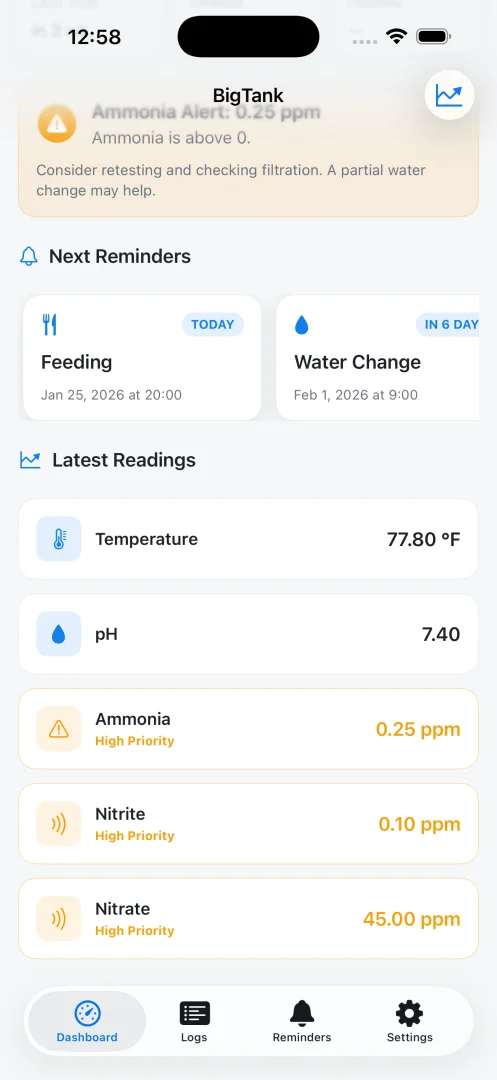
The reason all of this feels like a betrayal: you cannot smell ammonia. 0.25 ppm looks like nothing on a test strip. A fish that is slowly poisoned does not act dramatically — it goes quiet, sits at the bottom, and then it is gone. Owners describe the same shock every time: but it seemed fine yesterday.
"Could I have known?" — the honest answer
Sometimes yes. Sometimes no. But there is a real difference between "I have no idea what happened" and "here is what the water was doing in those two weeks."
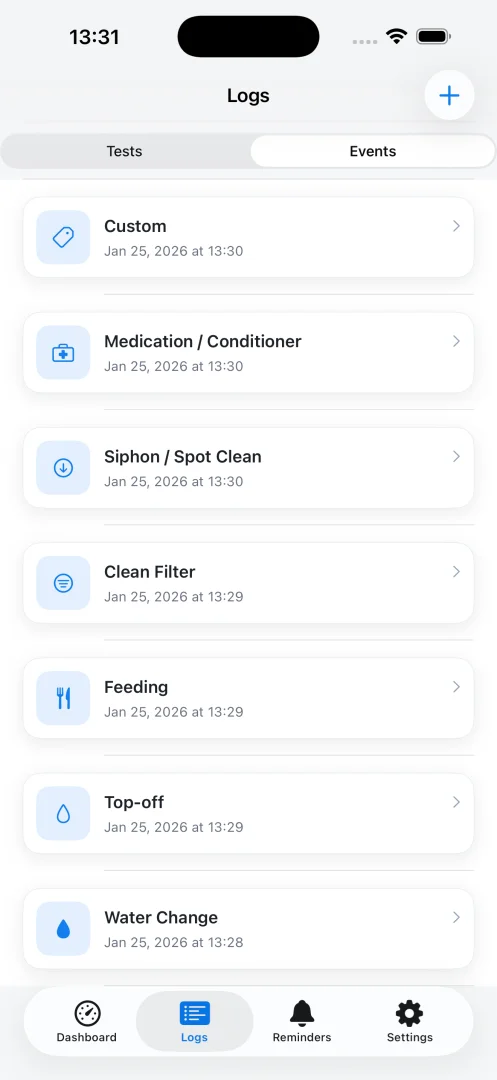
That difference is why many keepers write things down. Not just test results — pH, ammonia, nitrite, nitrate, temperature — but the ordinary care: water changes, filter cleaning, feeding, medication. It cannot prevent every loss. An aquarium can fail for reasons nobody can reconstruct.
What a record does is quieter, and it matters twice:
- It answers the guilt. Instead of a void, you have data — something to look at, to learn from, and to act on if you ever keep fish again.
- It becomes a record of the days. A log of feeding and water changes is, read honestly, a record of showing up for a small life every day. That is not a spreadsheet. It is proof of care.
What to do with the guilt
If you have been searching "did I kill my fish" at two in the morning, notice what that means: you are someone who is trying to do right by a creature that could not say thank you. That is care, not neglect.
The standard you are holding yourself to is omniscience — knowing what a closed system was doing at every hour, with no instruments and no warning. Nobody meets that standard. You did what you knew, with what you had.
If the guilt is sitting heavily, the same ideas we wrote for the decision that comes with an animal's death apply here almost word for word: you cannot out-know an invisible system, and loving something well was never the same as being able to control it.
Saying goodbye to something small
There is no funeral home for a fish, and no card for a turtle. So make your own small ritual, in whatever size fits:
- Put a smooth stone where you can see it, or plant something in their spot.
- Write one page — what they did that you never told anyone.
- Keep the tank photo. The one where the light hit the water.
- If there are children in the house, say it plainly: she died, and it is okay to be sad. They usually handle the truth better than the mystery.
And when you are ready to think about keeping again, it is worth reading when am I ready for another pet? — the questions are the same, only the tank is smaller.
Frequently asked questions
Do fish feel pain?
This matters because so many grieving owners worry their fish suffered. Fish have pain receptors and show clear physiological and behavioural responses to painful stimuli, and the scientific consensus is that they can experience pain. It is also worth knowing that ammonia poisoning in particular tends to make fish lethargic and still rather than thrashing — the quiet ending you saw was not the same as a violent one.
Why did my turtle die so suddenly?
Turtles hide illness extremely well — it is what keeps them alive in the wild. By the time a turtle looks unwell, a problem is often already advanced. This is not a sign that you were careless; it is a built-in limit of keeping a species that evolved not to show weakness. For anything ongoing or unclear, a vet experienced with reptiles is worth finding before you need one.
My fish died overnight. Should I restock right away?
Not yet. Whatever went wrong is still in the water — an ammonia spike does not clear itself because the fish is gone, and a disease does not leave with its host. Before adding anyone new, get the water tested and stable, and let the filter's bacteria recover. Restocking too soon is how a single loss becomes three.
Was it because I went away?
This is one of the most common weights people carry. A weekend trip, a work week with less attention — yes, disruptions can contribute. But an established, well-filtered tank is built to survive ordinary life, and tanks also fail during the most careful weeks. If you left, you did not abandon a child; you lived your life, as every keeper must.
It was not nothing
You do not have to defend this loss to anyone. You kept a small life alive for as long as you could, in a system that gives no warning and no second chances — and if the ending was quiet, that does not make it smaller.
Take the day if you need it. Tell someone. Keep the stone, the photo, the page.
Somewhere to keep them
PetLoss is a private, offline companion for pet grief — write to them, keep a memory timeline, and make something from the photos you have. It works for fish and turtles exactly as it does for any other pet: no account, no uploads, nothing to prove.
Download on the App StoreThis article offers information and emotional companionship; it is not veterinary or medical advice. If a tank problem is ongoing, consult a vet experienced with aquatic animals.
If you keep a tank — or want to remember this one
A tank journal is how many keepers turn "I have no idea what happened" into something they can actually read. FishTank Diary is by the same small studio as PetLoss, and built with the same rules: no account, no uploads, and it works fully offline.